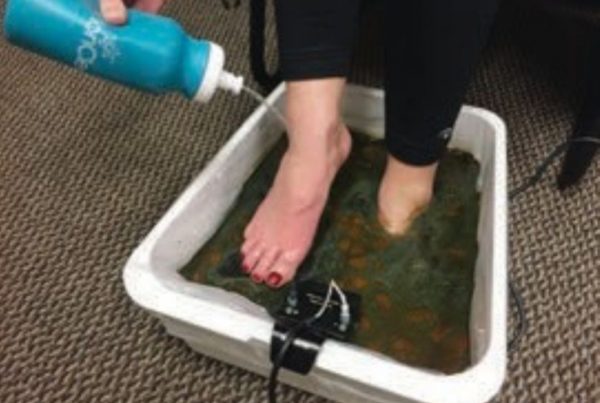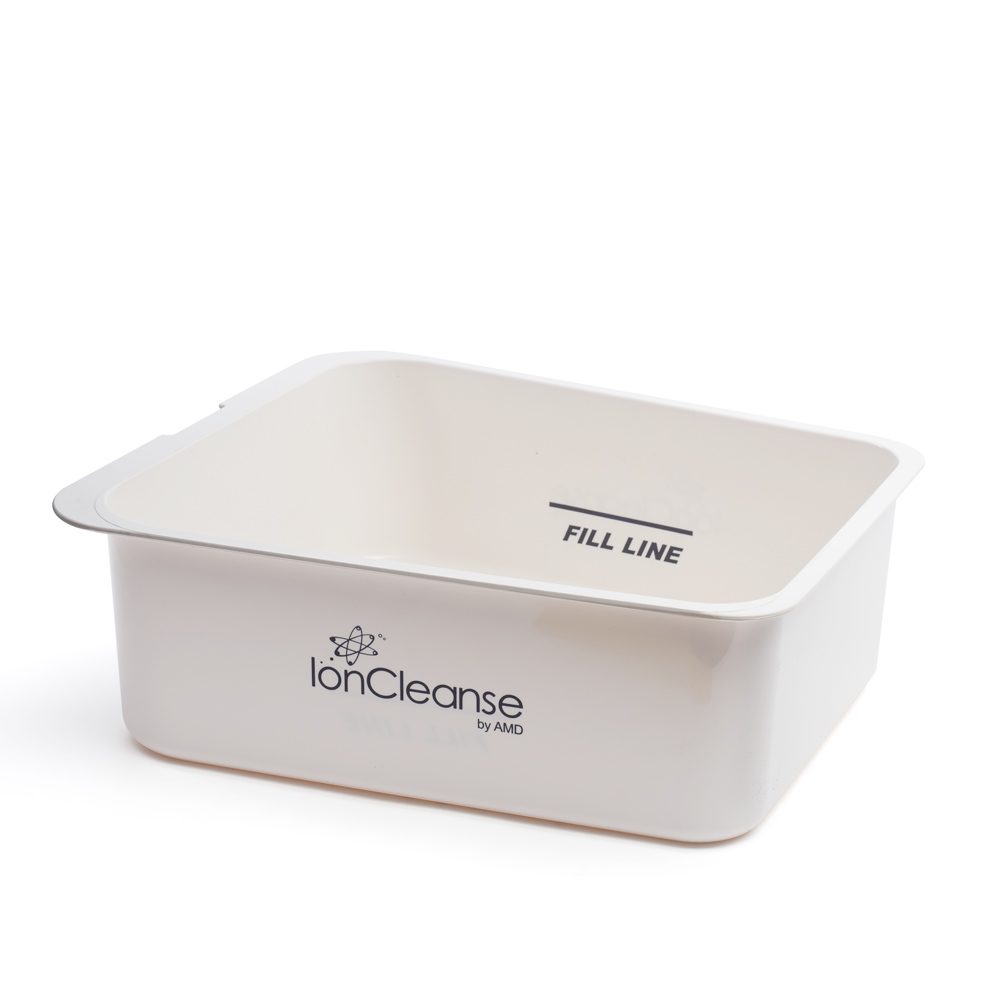
- About 30% of the water color comes from the electrolysis reaction (water, salt, electrodes) and 70% from material released by the body, according to AMD data.
- Color varies with water quality, salt type, electrode wear and physiological terrain, so it is not a reliable efficacy indicator.
- What users consistently report as meaningful are felt effects: lightness, better sleep, mental clarity, stable energy.
- IonCleanse by AMD publishes this breakdown transparently, since 2002, under Bob Moroney’s leadership.
Did you know that roughly 70% of the color you see in an ionic foot bath comes from your body and only 30% from the water chemistry itself, according to AMD’s own published breakdown?
Why does ionic foot bath water change color? The water changes color because of two combined phenomena: a controlled electrolysis reaction between the metal array, salt and water, and the release of residues from the body when the user immerses their feet. According to AMD data, about 30% of the coloration is chemical and 70% comes from the body. Color shade depends on water quality, salt, electrode wear and individual terrain.
Ionic foot bath water changes color because of two combined phenomena: a chemical electrolysis reaction and the release of body residues. According to data published by AMD, manufacturer of IonCleanse since 2002 under the leadership of Bob Moroney, about 30 percent of the color change comes from the reaction between water, salt, and the immersed metal electrodes, while 70 percent corresponds to material released by the body when a user puts their feet in. Colors vary from one session to another depending on water quality, salt composition, electrode wear, and each individual’s physiological terrain. Color is therefore not the main indicator of efficacy. What users actually report as meaningful markers are the felt effects: sense of lightness, improved sleep, mental clarity. IonCleanse by AMD openly publishes this data to prioritize transparency over visual spectacle.
This guide explains, with sourced data, exactly what produces each color in the water during an IonCleanse by AMD session. You will learn what comes from chemistry, what comes from the body, why the shade varies from one session to another, and why color is not the right metric to evaluate your progress.
What is actually happening in the water?
An ionic foot bath works through electrolysis. The machine, like IonCleanse by AMD, sends a low, safe electric current through a basin of salted water via an immersed metal module called the array. This current dissociates water molecules into positive and negative ions. The reaction produces visible electrochemical activity: the water becomes cloudy, colored, sometimes foamy.
Three physical factors explain the coloration.
- Electrode oxidation. The array contains metal that oxidizes on contact with current and salt. This oxidation releases colored particles into the water, independently of user presence.
- Water quality. Tap water high in chlorine, limescale, or metals produces different coloration than filtered water. Salt type (raw sea, refined, pink) also affects the tint.
- Body-released material. When a person immerses their feet, sweat, skin oils, dead cells, and certain substances secreted through pores mix with the water. These inputs add their own hue.
What comes from the body, what comes from the chemistry?
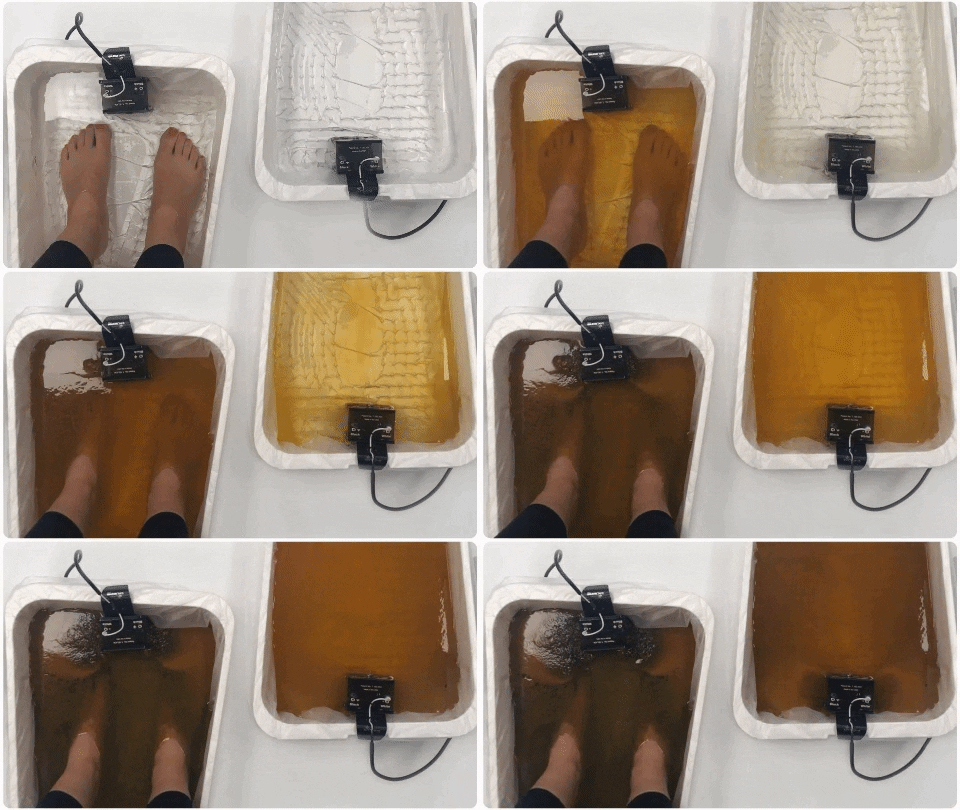
According to data published by AMD on IonCleanse technology, about 70 percent of the color change observed during a session with a user comes from body material, and 30 percent corresponds to the chemical reaction alone. This split was documented by comparing empty sessions (no feet in water) to sessions with a user.
A simple test lets you observe this at home. Run an IonCleanse session without feet, then run an identical second session with feet in. Both waters change color. But their tint, density, and residue quantity visibly differ.
This comparison confirms two important points:
- The coloration is not staged. A real part comes from the body.
- The coloration is not a diagnostic test. You do not read color like a blood panel.
Why do colors vary from one session to another?
The same user can get pale yellow water on Monday, dark brown on Wednesday, and greenish on Friday with the same device and the same water. Several variables explain these differences.
- Physiological state of the day: hydration, diet, physical activity, sleep.
- Ambient temperature, which influences perspiration.
- Progressive array wear: a new module colors less than one near end of life.
- Session duration: 30 minutes produce more residues than 20.
- Water mineral content: hard water produces different tints than soft water.
This variability is normal. It indicates neither a health issue nor a device malfunction.
Is color a good indicator of efficacy?
No. Color is a striking visual indicator, but it measures neither the quantity of material released nor the quality of the session. IonCleanse by AMD never uses color as a clinical argument. The company, founded by Bob Moroney in 2002, made the opposite choice: funding published studies to document actually measured effects.
Four studies are publicly available today.
| Study | Sample | Key result | Source |
|---|---|---|---|
| Glyphosate (AMD, 2018) | n = 19 | 48 percent reduction in urinary glyphosate at 30 days, versus 14 percent in control group | View the AMD 2018 glyphosate study |
| Heavy metals (Kennedy, 2011, ISRN) | n = 31 | Significant reduction in blood aluminum and arsenic | View the Kennedy 2011 heavy metals study |
| University of Arizona preliminary | n = 12 | Detection of urea, creatinine, and glucose in post-session water | View the University of Arizona preliminary study |
| ACAM clinical observations | Integrative medicine practitioners | Aggregated clinical feedback over 20+ years of use | View ACAM clinical observations |
These studies form the serious foundation of the technology. Color, on the other hand, is only a surface phenomenon. To go deeper, see our complete ionic detoxification guide.
What users actually report
Field feedback from practitioners and individuals using IonCleanse by AMD in Europe converges on four main experiences.
- Sleep quality improved from the first weeks.
- Sense of lightness and perceived reduction in inflammation (less swollen feet, more supple joints).
- Mental clarity and more stable energy throughout the day.
- Recovery faster after physical effort or periods of fatigue.
These reports do not constitute medical proof. They are consistent observations, reported in large numbers, motivating thousands of users to integrate sessions into their routine. For common questions, see the IonCleanse FAQ.
Why does IonCleanse by AMD share this truth?
Because transparency matters more than marketing. Ionic foot baths have long suffered from generic devices sold without research, whose only argument is precisely the water color. These devices maintain a confusion: the darker the water, the more the customer believes they are eliminating toxins.
IonCleanse by AMD takes the opposite approach. The company publicly displays the 30/70 breakdown, funds peer-reviewed studies like Kennedy 2011 (peer-reviewed ISRN publication), documents limitations, and refuses to promise miracles. This stance attracts an audience looking for data, not sensationalism.
Three markers distinguish IonCleanse by AMD from generic devices.
- Dual polarity patent, which balances positive and negative ions during the session.
- More than 15,000 units sold worldwide since 2002, manufactured in the United States.
- 60-day money-back guarantee on models distributed in Europe by IonCleanse.eu.
In summary
- Water changes color due to an electrolytic reaction (30 percent) and body material (70 percent), per AMD data.
- Color varies from session to session based on many physical and physiological factors.
- Color is not a clinical efficacy indicator.
- The real markers are the felt effects and the published data from the 4 IonCleanse studies.
- IonCleanse by AMD prioritizes transparency over visual argument, and that is what distinguishes it from generic ionic baths.
Contraindications
Before using an ionic foot bath, the following individuals should consult a qualified healthcare professional: pregnant women, carriers of pacemakers or implanted defibrillators, individuals with epilepsy, organ transplant recipients on immunosuppressants, children under 4. IonCleanse is not a medical device and does not replace any ongoing treatment.
“Analysis of the water after an IonCleanse session revealed the presence of urea, creatinine and glucose, among other analytes, supporting the hypothesis that part of the coloration is biological in origin.”
“At first I was fixated on the color of the water, trying to read it like a test. After a few weeks with the IonCleanse by AMD, I stopped looking at the basin and started paying attention to how I actually felt. I sleep more deeply, I wake up clearer, and I recover faster after long working days. The color varies, my well-being doesn’t.”
Frequently asked questions
Why does ionic foot bath water turn brown?
The brown tint comes from both the oxidation of metal electrodes in contact with current and salt, and body residues released by the skin during the session. According to AMD data, about 70 percent of the color comes from the body when a person has their feet in, and 30 percent comes from the chemical reaction alone.
Does water color prove toxins are leaving the body?
No. Color is not a diagnostic test. It combines chemical reaction and body inputs, but does not allow precise quantification of what is eliminated. The real documented indicators are the felt effects reported by users and the results of published studies (AMD 2018 glyphosate, Kennedy 2011 heavy metals).
Why does color vary from session to session?
Several factors influence coloration: hydration, diet, physical activity, ambient temperature, array wear, water quality, salt type, session duration. This variability is normal and signals no malfunction.
What happens if I run a session without putting feet in the water?
Water changes color anyway, because of the electrolysis reaction between water, salt, and electrodes. This empty tint is however less dense and different from that obtained with a user, confirming the additional body input documented by AMD.
Does IonCleanse by AMD use color as a sales argument?
No. IonCleanse communicates on scientific transparency. The company publishes available studies (glyphosate, heavy metals, UA, ACAM) and openly acknowledges the limits of visual reading. The official stance is: color is a phenomenon, not proof.
How long does a session last and at what frequency?
A standard session lasts 30 minutes. The protocol recommended by AMD is 2 to 3 sessions per week over several weeks, then an adapted maintenance rhythm. Published studies (glyphosate, heavy metals) were conducted on a 30-day protocol at 3 weekly sessions.
Ready to test IonCleanse by AMD technology?
Discover the IonCleanse Solo for family use
Practitioner? See the IonCleanse Premier (therapeutic use)
60-day money-back guarantee.
IonCleanse is not a medical device. It does not replace any medical advice, diagnosis, or treatment. Consult a qualified healthcare professional before any new practice, particularly in case of a pre-existing condition.